On March 5, six days into the war with Iran, Adm. Brad Cooper stood at U.S. Central Command headquarters in Tampa and was asked how much a new, cheap attack drone had helped his campaign. “LUCAS, indispensable,” he told a reporter from The War Zone. Asked what the drones had been fired at, he gave a two-word answer: “Good ones.” Twelve days later Emil Michael, the Pentagon’s chief technology officer, described the inventory behind that verdict. “We’re not producing tens of thousands of these. They’re in the dozens, but they work very well so far,” he said at a defense conference, according to DefenseScoop.
Seven months on, the distance between those two statements is still the story of the Low-cost Uncrewed Combat Attack System, the American copy of Iran’s Shahed-136. This article sets out what the public record establishes about LUCAS, which is that it was fielded fast and has been used in combat. It also sets out what remains an official claim, including the cost of each shot, the number fired and the damage done. And it weighs the most detailed analysis so far of what cheap long-range drones can substitute for in the U.S. arsenal, which turns out to be less than the price tag suggests and more than skeptics allow.
A target drone that became a weapon in seven months
The idea predates the current administration. Michael Horowitz, who ran emerging-capabilities policy in the Pentagon from 2022 to 2024, told The War Zone in April that the concept reached his desk in May 2024, that the money involved was in the tens of millions of dollars, and that then-Deputy Secretary Kathleen Hicks was eventually persuaded to back it. He credited Alex Lovett, a prototyping official in the research and engineering office, with finding the concept and keeping it alive. When the Biden team left, Horowitz said, the effort was “moving forward, but not yet a fielded capability.”
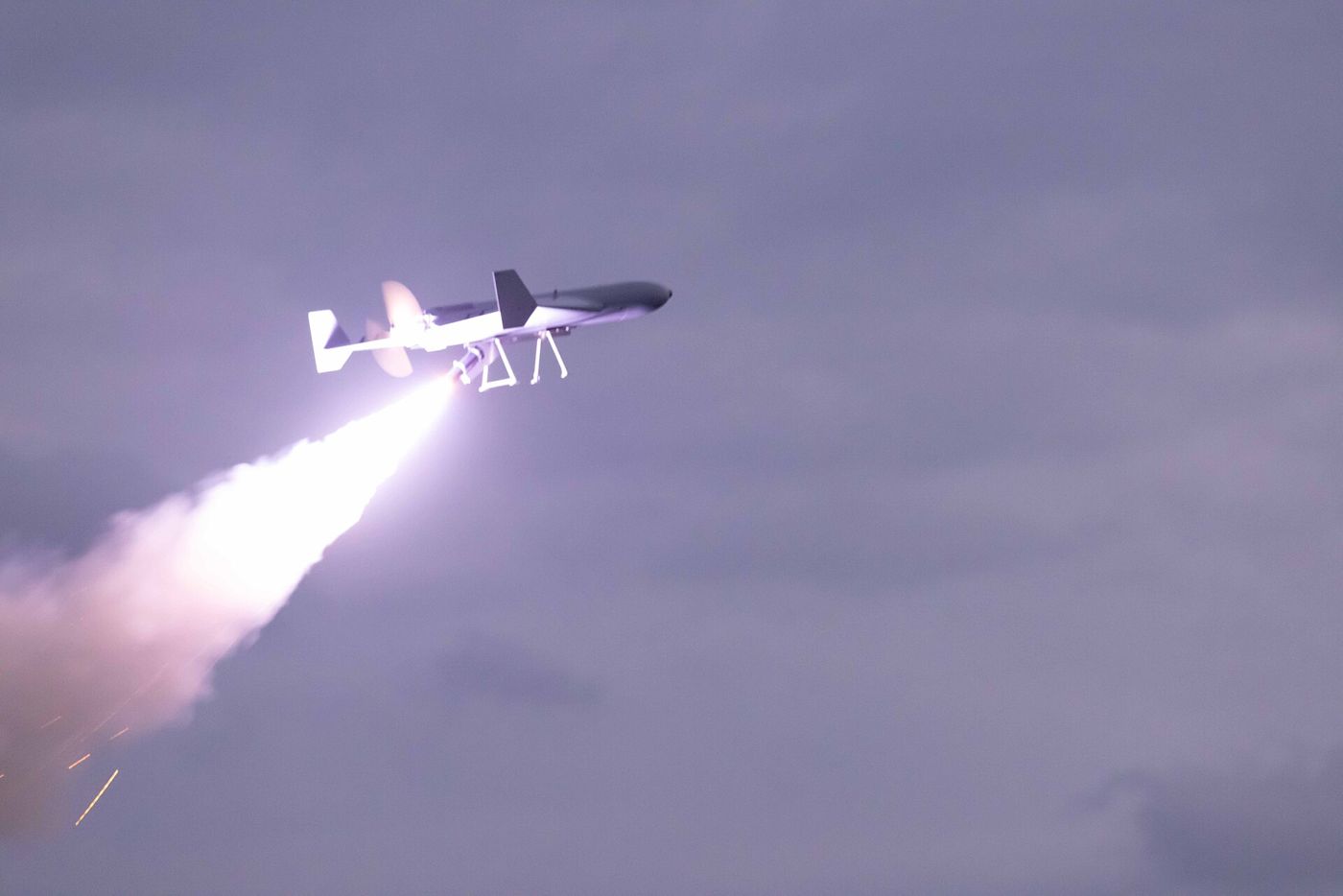
The airframe came from SpektreWorks, an Arizona company that sells a Shahed look-alike called the FLM 136 for threat emulation. The company’s published specifications list a range of 444 nautical miles, six hours of endurance, a 74-knot cruise speed and a maximum payload of 40 pounds on an aircraft with a maximum weight of 180 pounds. The War Zone has cautioned that it is unclear whether those figures describe the weaponized version, and it cites U.S. Army training data crediting the original Shahed-136 with roughly 1,242 miles of range and an 88-pound warhead. On the public numbers, the copy is the smaller aircraft.
SpektreWorks showed the drone in the Pentagon courtyard in July 2025, Defense One reported. On December 3, Central Command announced Task Force Scorpion Strike, a one-way attack drone unit that a U.S. official told The War Zone numbered about two dozen troops. Thirteen days later a LUCAS was rocket-launched from the littoral combat ship USS Santa Barbara in the Arabian Gulf.
The weapon was still immature. In a December Army release quoted by The War Zone, Col. Nicholas Law, the research and engineering office’s director of experimentation, said the warhead intended for LUCAS had not yet been built and that testers at Yuma Proving Ground were flying inert payloads. Central Command declined at the time to say whether its deployed drones carried explosives. Law also described the production concept: an aircraft “designed to go to multiple manufacturers to be built in mass quantities.”
On February 28, Central Command said Task Force Scorpion Strike was using one-way attack drones in combat “for the first time in history” as Operation Epic Fury began. Retired Rear Adm. Lorin Selby told Aerospace America that the program took seven months from public unveiling to combat. That timeline is the best-documented fact about LUCAS, and nobody in the debate disputes it.
Combat use is confirmed, and the effects are not
What the drones did is another matter. Cooper said in a March 3 video that the task force had launched “countless one-way attack drones.” Michael’s “dozens” came two weeks later, along with the admission that the drones “were not in full-rate production” and that the department had shipped what it had. A Central Command official, asked on the first day how many aircraft the unit held, told Defense One: “Don’t think of it as a traditional squadron; it could be 100 or 2,000.” The official would not say how many were used. When LUCAS drones flew again in an overnight attack on April 7, a command spokesman confirmed their part to DefenseScoop but gave no quantity, target type or launch location.
No official source reviewed for this article has released a count of LUCAS sorties, a target list, a hit rate or a figure for losses to Iranian defenses. Wayne Phelps, a retired Marine officer who has written a book on drone warfare, said in March that it was “too early to determine the effectiveness of LUCAS from open-source reporting.” The public evidence has barely improved since. In a report published September 18, the Center for a New American Security recommended that Congress require the department to brief lawmakers on the drone’s tactical and operational effects in Epic Fury, a request that implies the authors had not seen such an accounting.
Outside estimates of scale point the same way. The CNAS authors wrote that the overwhelming majority of U.S. strikes on Iran were flown by advanced aircraft and precision missiles. Mark Cancian and Chris Park of the Center for Strategic and International Studies, assessing stockpiles after the first 39 days of the campaign, concluded that the United States used some LUCAS drones but “did not have enough to match the salvos launched by Iran in this war or by Russia in Ukraine.”
The price tag depends on what is counted
The number attached to LUCAS in almost every account is $35,000. Its source is a Central Command spokesman, Capt. Tim Hawkins, who gave it to The War Zone in December as the approximate cost “per platform.” DefenseScoop has separately reported that the price of the LUCAS family is said to range from $10,000 to $55,000. Neither figure has been broken down in public into airframe, warhead, datalink and launch equipment.
One of those items became a dispute in May. Reuters reported, in an account summarized by The War Zone, that SpaceX had pressed the Pentagon to pay about $25,000 rather than $5,000 to connect each drone’s satellite terminal, and that the department agreed. Chief Pentagon spokesman Sean Parnell called the claims “simply not based in reality.” If the Reuters account is right, the cost of a connected LUCAS approaches $60,000. That is still a small fraction of a Tomahawk’s price, but the datalink that lets the drone be controlled after launch comes from a single commercial supplier.
Cost per drone is also the wrong unit for some purposes. Brandon Tseng, president of Shield AI, which says it was selected to put its Hivemind autonomy software on LUCAS, made the point while selling his product: if it takes 10 or 20 cheap drones to destroy a target, he told The War Zone, “they’re no longer that cheap.” The company plans a demonstration this fall in which one operator directs a LUCAS swarm. Tseng said any fielding timeline belongs to the government.
Dozens built, while the model is tens of thousands
The case for LUCAS rests on quantity. Horowitz’s arithmetic is that the money for 400 Tomahawks would buy about 46,000 LUCAS rounds, and he argues for “tens of thousands to hundreds of thousands” of such systems. Because the government owns the design, he said, many vendors could build it at once, the approach Law compared to wartime Liberty ships. A second company, Griffon Aerospace, already offers a larger Shahed-type drone, the MQM-172 Arrowhead, which its spokesman told The War Zone can carry 100 pounds as far as 1,500 nautical miles. That is a company claim.
The documented production base is far smaller. SpektreWorks received a $30 million award in fiscal 2025 from the Pentagon’s APFIT fund, according to The War Zone; Horowitz called that kind of money a bridge to production for systems that are not yet programs of record. For comparison, the Institute for Science and International Security has estimated that Russia’s Alabuga plant, which aimed for 25,000 Shahed-type drones a year, was probably building closer to 18,540.
Money may be coming. The White House’s June 24 supplemental request lists $2.4 billion for drones alongside $21 billion for munitions, but, as DefenseScoop noted, it names no platforms. No public document reviewed for this article states how many LUCAS drones have been delivered since March, what the monthly rate is, or whether a second manufacturer is under contract to build the SpektreWorks design. Testing continues: on September 17 “a LUCAS UAS impacted the water during routine scheduled testing on the Eglin AFB Range,” the base told Task & Purpose, after a charter fishing boat hauled the airframe out of the Gulf.
Against China, the arithmetic favors mixed salvos
The CNAS study by Philip Sheers and Stacie Pettyjohn is the first detailed public attempt to test the substitution argument against a harder opponent, and its findings cut both ways. Using a notional extended-range LUCAS priced at $100,000 with a 100-pound warhead, the authors modeled an attack on Huian, a Chinese fighter base 270 kilometers from Taiwan. Cutting the runways and hitting exposed aircraft took 96 JASSM-ER cruise missiles at $192 million, or a package of roughly 240 drones and eight missiles at about $40 million. In that case the cheap weapon does most of the work for a fifth of the cost.
Change the target and the result reverses. Against a Renhai-class cruiser, the model required 140 notional $200,000 antiship drones to match six Long Range Anti-Ship Missiles, and the drone salvo cost almost $11 million more. “A lower unit cost does not translate into a cheaper salvo when many more rounds are required,” the authors wrote. Against the base’s buried aimpoints the drone’s assumed effectiveness was zero. Roughly half of more than 1,500 ground targets on the Chinese mainland lie too deep inland for range-limited weapons to reach at all. The report’s conclusion is that the value of affordable mass lies in “supplementing existing capabilities rather than replacing them.”
People who built and used the weapon say similar things. Horowitz: “These weapons are accurate. They’re just pretty easy to shoot down.” Selby: “you don’t send LUCAS after a hardened bunker.” Cooper himself, asked by a House Armed Services Committee member in May what he needed more of, listed electronic warfare, counter-drone systems and weapons for hard and deeply buried targets. “Everybody is going underground,” he said. CSIS adds a point about the low end: a guided 1,000-pound bomb costs less than $100,000, so wherever U.S. aircraft can fly overhead, LUCAS and its 40-pound warhead are not the cheapest way to deliver explosives. Its niche is reaching about 500 miles without risking an aircraft.
The strongest objection to this cautious reading comes from the war itself. Maximilian Bremer and Kelly Grieco of the Stimson Center argued in Breaking Defense that the United States won the high-altitude contest over Iran and lost a second one near the surface, where slow Shaheds that are easy to shoot down still wrecked radars, disrupted oil production and struck ports. On that account the weapon’s weaknesses did not stop it from shaping the outcome, and the arsenal built for precision was the one that came up short. A modeling exercise by three Navy and Marine Corps officers in War on the Rocks reached a compatible result: when an entire drone fleet can be launched at once, the plainest version outperforms upgraded ones. Both arguments depend on numbers the United States does not yet have. In the Stimson authors’ words, “a $30 million contract producing hundreds of drones still leaves the US outmatched.”
Decisions that are still open
Several choices now sit with identifiable people. Central Command and the research and engineering office hold the strike data from Epic Fury; whether any of it is released, or briefed to Congress as CNAS proposes, is for Cooper and Michael to decide. Appropriators will determine how the $2.4 billion drone request is divided and whether to fund the multiyear contracts that the CNAS authors say industry needs before it expands capacity.
Ownership inside the Pentagon is also unsettled. Defense Secretary Pete Hegseth said on September 30 that a four-star Autonomous Warfare Command will stand up by October 1, 2027, with the existing unmanned-systems portfolio office, renamed Project Agincourt, clearing the way. Nothing published so far says whether LUCAS moves there, becomes a service program or stays a prototype bought in batches. The Air Force planned an experimental one-way attack unit for mid-2026 to test launches at 600 to 1,000 miles, a span Pettyjohn told Air & Space Forces Magazine should be longer; the service has not said in any account reviewed here what that unit will fly. In the Middle East, Central Command announced a multinational successor to Scorpion Strike in August without naming a partner.
The remaining question is one of design discipline, and it belongs to whoever ends up writing the requirement. Every proposed improvement, from autonomy software to a bigger warhead, longer range or a secure satellite link, addresses a real shortfall and adds cost to a weapon whose argument is its price. CNAS urges the department to keep such weapons “highly producible” and minimally viable. Whether the next production lot of LUCAS is ordered by the thousand at something near $35,000, or by the hundred at a higher figure with more capability, has not been announced.
This analysis draws on the public sources linked in the text. Send corrections to info@defenseautonomyreview.com.