
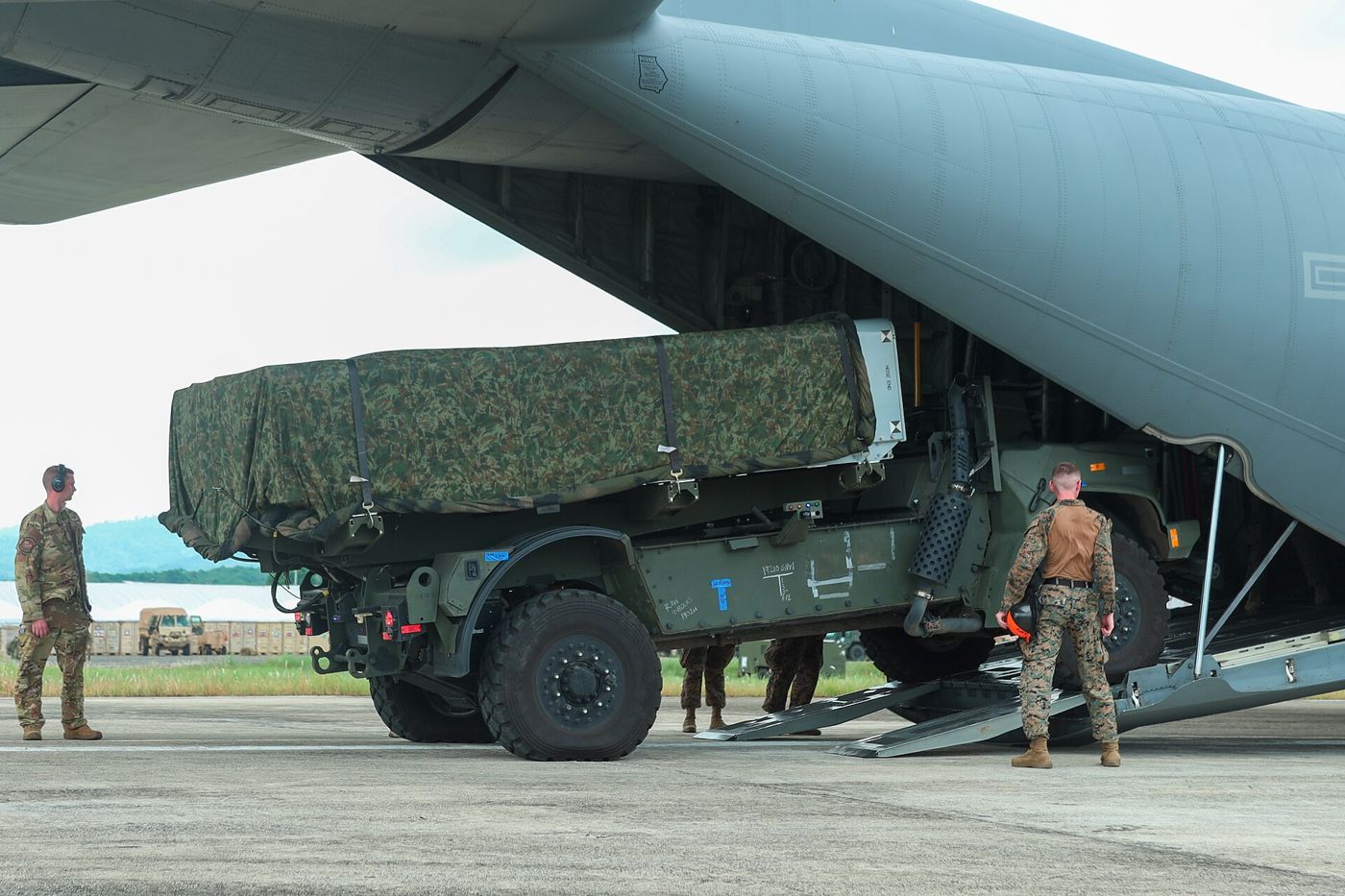
On April 26, 2025, Marines from the Medium-Range Missile Battery of the 3d Marine Littoral Regiment loaded a missile launcher onto an Air Force C-130J at Lal-lo, in northern Luzon. The official caption identifies the cargo as a Navy-Marine Expeditionary Ship Interdiction System, or NMESIS. The launcher was bound for the Batanes islands in the Luzon Strait, where the system first reached Basco and Batan during Exercise Balikatan 25. The vehicle under the missiles carries no crew.
NMESIS is the rare American ground robot that has left the test range and joined a unit. The reason is less flattering to robotics than its admirers might like. The Marine Corps fielded an uncrewed vehicle by asking it to do very little on its own. The vehicle carries missiles to wherever a nearby Marine sends it. Autonomy was treated as an upgrade to be bought later. That ordering deserves study by anyone trying to move other uncrewed ground vehicles out of prototype status.
A launcher that is driven, not autonomous
The system pairs Kongsberg’s Naval Strike Missile with the Remotely Operated Ground Unit for Expeditionary Fires, or ROGUE-Fires, a Joint Light Tactical Vehicle that runs with no operator aboard. Early descriptions were ambitious. In 2021, Breaking Defense reported that Marines could drive the vehicle with a game-style controller or order several launchers to follow a crewed leader vehicle on their own. That August, during Large Scale Exercise 2021 at Kauai, the system fired and hit a decommissioned ship twice.
What the service authorized for fielded units was narrower. In May 2025 a Marine Corps Systems Command spokeswoman told Defense One that NMESIS was cleared to operate in towed, tele-operated and wired garrison modes, and described it as “tele-operated, neither autonomous nor unmanned,” with human operators in the loop for both movement and firing. Leader-follower operation would come, she said, as the technology matured. The same report noted that Oshkosh had received a $30 million contract modification earlier that year to integrate newer autonomy, including self-driving software from Forterra. In June 2026, Inside Defense reported that the Corps had awarded contracts to put autonomy software into the platform, calling it the Pentagon’s first large-scale production contract for ground vehicle autonomy.
The sequence is the lesson. A launcher that can be towed into position and nudged by remote control meets the operational need, which is to keep Marines away from a vehicle that becomes a target the moment it fires. Nothing beyond that stood between the program and a fielding decision.
Fielded in Hawaii and Okinawa, fired only in test
The fielding record is short and well documented. The 3d Marine Littoral Regiment received NMESIS at Marine Corps Base Hawaii on November 26, 2024, becoming the first unit to field it; Military Times put the number at six systems. Five months later the battery was in Batanes. It returned to the same islands for KAMANDAG 9 in late May 2025, and went to Camp Ishigaki in Japan for Resolute Dragon that September. A Marine Corps release says the system also supported Balikatan 26, and records its arrival with the Okinawa-based 12th Marine Littoral Regiment in June 2026. Later this month, during Keen Sword, Stars and Stripes reports the 12th will take the system to Yonaguni, about 70 miles from Taiwan, for the first time.
The categories should be kept separate. A live shot against a ship was demonstrated at Kauai in 2021. Two regiments now hold the equipment. In the forward deployments, though, no missile has left the canister: Naval News reported that fire missions in Batanes were simulated, Resolute Dragon training at Ishigaki was announced as taking place without live fire, and a Japan Joint Staff spokesman told Stars and Stripes that nothing will be fired during Keen Sword. The exercises show that a small battery can fly a robotic launcher to a remote island and set it up. Whether the kill chain behind it holds up under jamming and at range is a separate question that the public record does not answer.
Why the narrow robot won
Several features of the program made a fielding decision easy to reach. The vehicle is a variant of an existing tactical truck, and the missile was an existing design. The system has one user with a clearly written mission; the commander of 3d MLR described that task as “Attack Enemy Maritime Targets.” The robot is never asked to find a target or decide anything. A launcher sits still for most of its working life, so the hard problem of off-road perception that industry engineers describe as the obstacle for ground autonomy matters only during short moves, and a tow bar covers the gap when software cannot.
Programs that specify a robot able to maneuver alongside troops take on the full autonomy problem at the outset. NMESIS started with a job in which removing the crew was the whole point and driving was incidental.
The program is now moving into the phase where that discipline will be tested. Marine officials have spoken of an inventory of 261 systems, and Inside Defense cites a goal of 18 launchers per battery by fiscal 2033. A battery that size cannot be towed and joysticked into position one vehicle at a time, so leader-follower stops being optional. The Corps should publish what its operational testing found about remote-control links and mobility, and should put a live shot from a forward island on the exercise calendar where host nations allow it. Program offices elsewhere should copy the method by picking a mission where removing the crew pays for itself and fielding the teleoperated version first, with autonomy added under contract once units are using it.
This analysis draws on the public sources linked in the text. Send corrections to info@defenseautonomyreview.com.
.jpg)