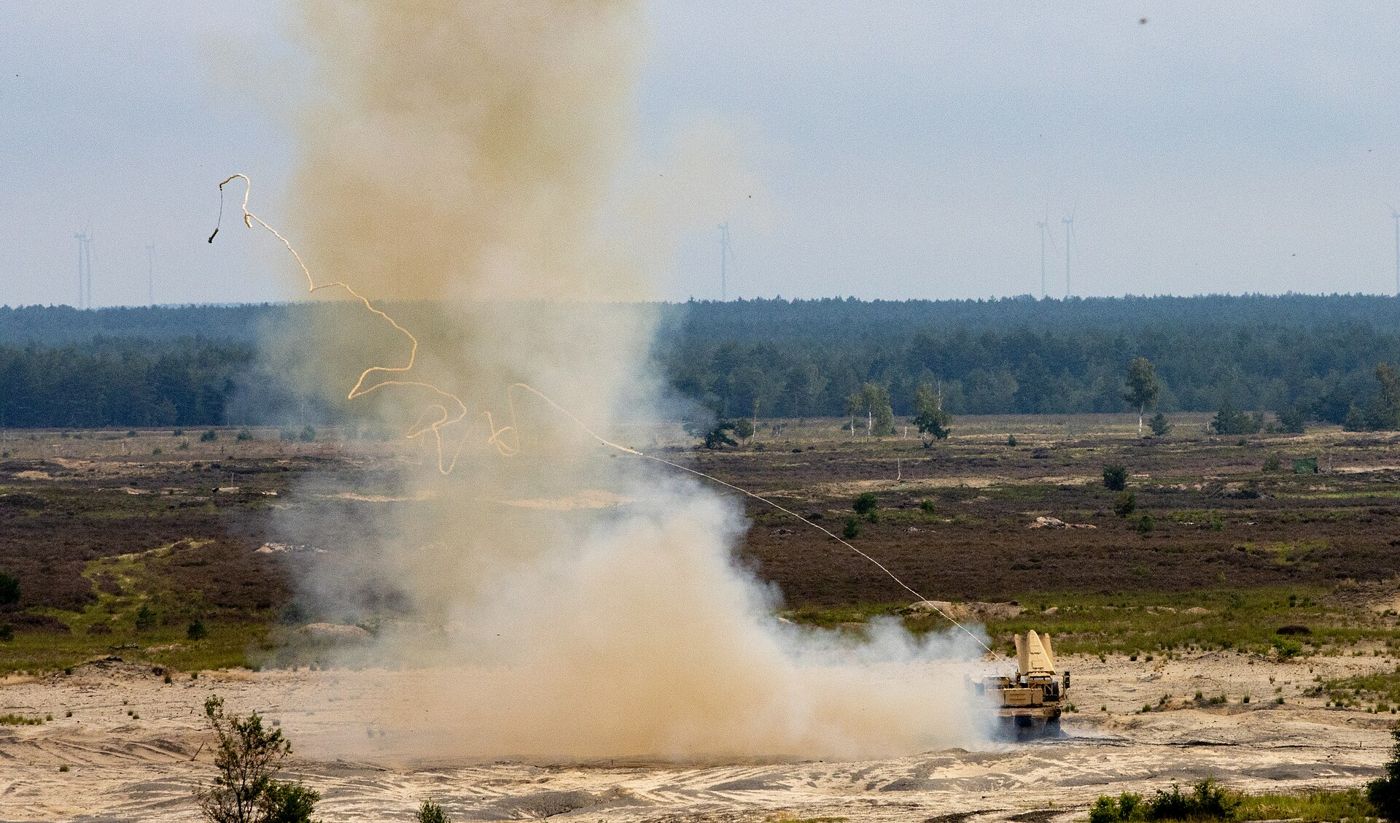
Early on 4 June 2023, Ukrainian engineers fired two UR-77 line charges across the narrowest part of a minefield north of Novodarivka and blew two lanes, each six meters wide. The Royal United Services Institute’s Stormbreak report records what followed. In the eastern lane, vehicles bogged, the cleared strip was too narrow for others to pass, Russian tanks unmasked and the column was knocked out vehicle by vehicle. In the western lane a second company tried to speed up, strayed off course, and every vehicle was immobilized by mines. The explosive part of the breach had worked.
That sequence should frame how the U.S. Army judges its newest engineer program. In early July 2026 the service selected Caterpillar, Forterra, IDV USA and Overland AI for the Engineer Autonomous Breaching Capability, with demonstrations leading to a unit assessment in early 2027. Taking sappers out of the lane is worth the money. Seven years of experiments, though, have mostly shown that an uncrewed vehicle can drive to an obstacle and fire a charge. They have not shown that a robotic breach holds up against jamming, observation and depth, or that a crewed force can follow it through. The 2027 assessment should be designed around those gaps.
Experiments show the machine works on a range
The Army has had a remotely driven M1150 Assault Breacher Vehicle since at least 2019. At the Joint Warfighting Assessment at Yakima Training Center that May, Defense News reported, Marines controlled two robotic breachers from a single command vehicle while a robotic Polaris MRZR held a smoke plume for about 30 minutes. The control link was already the worry. A year earlier, an Army battle lab official said, operators could get only 500 to 800 meters from the robot, so engineers added a tethered drone to rebroadcast the signal. Gen. Mike Murray told Defense News, “I worry about the links in terms of it being secure.” The battalion commander on the ground added that “jamming is a threat.”
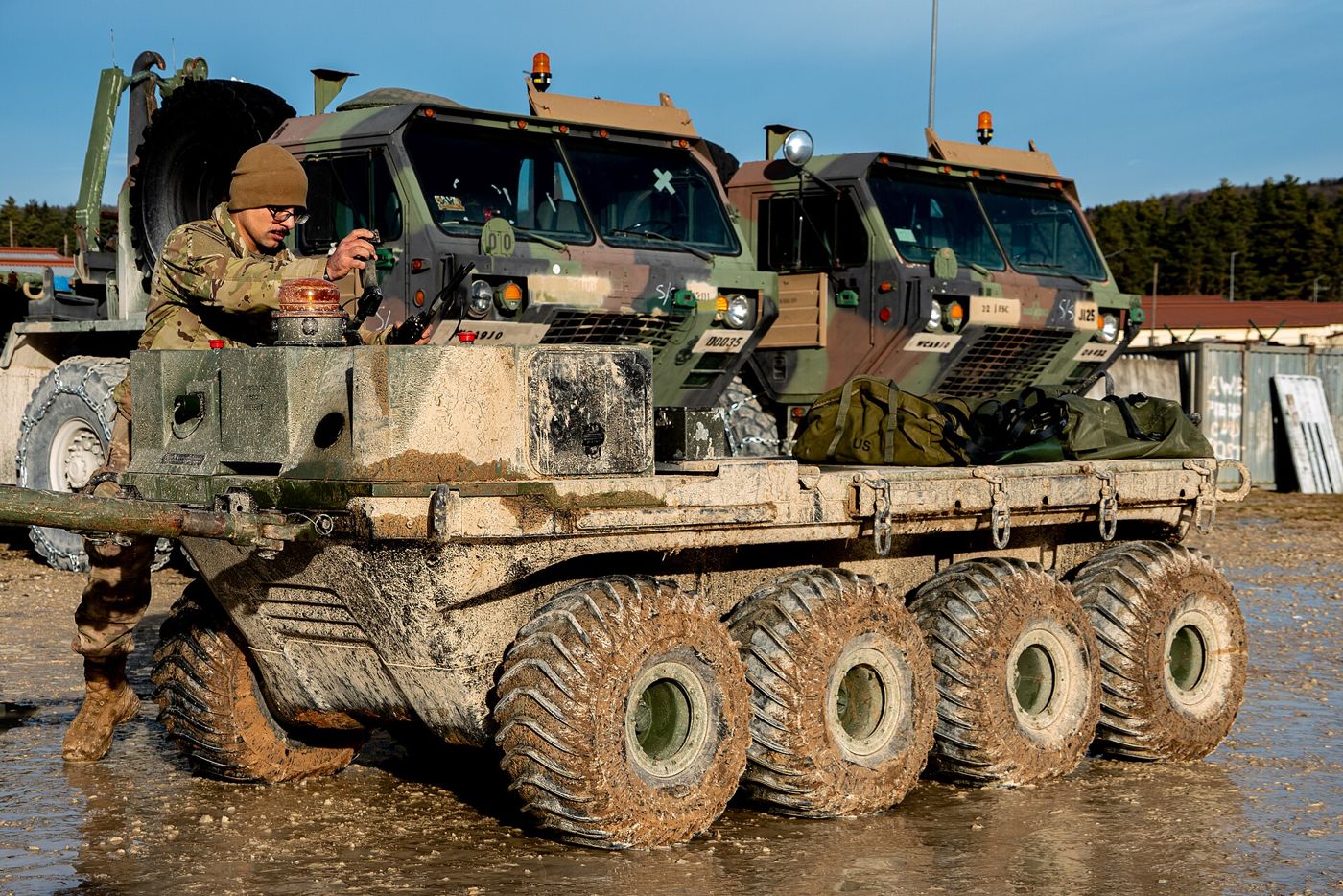
In May 2022 the Army contracted Cybernet for a robotic kit for the breacher, an award the company valued at $3 million with options. The most visible work since has come from the XVIII Airborne Corps’ Sandhills Project. On 1 August 2024 at Fort Irwin, Defense One reported, an uncrewed M113 fired a line charge and cleared an eight-yard lane. The project’s director said remote-control signals were sometimes drowned out by radio emissions from other friendly systems. At Project Convergence Capstone 5 in 2025, Overland AI says, soldiers of the 27th Engineer Battalion ran its autonomy on a small vehicle towing a mine-clearing drone trailer for two weeks. In July 2026 Janes reported that Sandhills was fitting counter-drone shotgun turrets to its vehicles after sending an unprotected ground robot to Ukraine.
None of this is fielded. The new program’s own language sets a higher bar than any of these events met: the Army wants systems that breach “under direct observation and fire” with “beyond-line-of-sight autonomous control.” One award has a public price, a $20 million contract to Overland AI reported on 10 September 2026.
Ukraine’s breaches failed after the charge went off
An Army captain’s study of the 2023 counteroffensive, published by the service in July 2025, gives the numbers a robotic breach has to beat. Ukraine advanced about 20 kilometers at a cost of 518 vehicles, including 91 tanks and 24 engineering vehicles. Russian minefields grew from a doctrinal 120 meters deep to 500, and one lane through a 500-meter obstacle takes six line charges. The charges had a 60 percent detonation rate and left about a quarter of the mines intact, so every lane still had to be proofed.
Removing the crew changes none of that arithmetic. It also sharpens a conflict the same study documents. Only 3 percent of Ukrainian fire missions included smoke, because smoke blinded the headquarters that were tracking the fight by drone. A teleoperated breacher depends on video even more than a commander does, so the smoke that hides it from an antitank missile team also degrades its operator’s picture. Russian electronic warfare, the study adds, spread to limit Ukrainian communications. A robot whose link drops inside a six-meter lane becomes the obstacle Murray described in 2019, an 80-ton vehicle that cannot be pushed aside.
Then comes the force that follows. The western column at Novodarivka was destroyed by leaving a lane that had been cleared. The assault force will still be crewed, and it will cross under the first-person-view drones that a Ukrainian platoon leader quoted in the Army study said had replaced mines as the main problem. Lane marking that a tired driver can follow is as much a part of the breach as the charge.
What the 2027 assessment should have to prove
An Army spokesperson told Breaking Defense that officials have yet to decide whether to narrow the field. Before the assessment, the service should publish pass-fail conditions drawn from Ukraine. The breach should be run against an opposing force that is jamming the control link and flying its own drones, with operators beyond line of sight. The obstacle should be 500 meters deep. Smoke should be thick enough to blind enemy observation, and the robots should have to work inside it. At least one robot should be disabled mid-lane to see whether the others can recover it or cut a bypass.
Most of all, the event should end only when a crewed company has driven the marked lane at night without a simulated mine strike. A production decision made on anything less would be buying the part of the breach that already worked at Novodarivka.
This analysis draws on the public sources linked in the text. Send corrections to info@defenseautonomyreview.com.