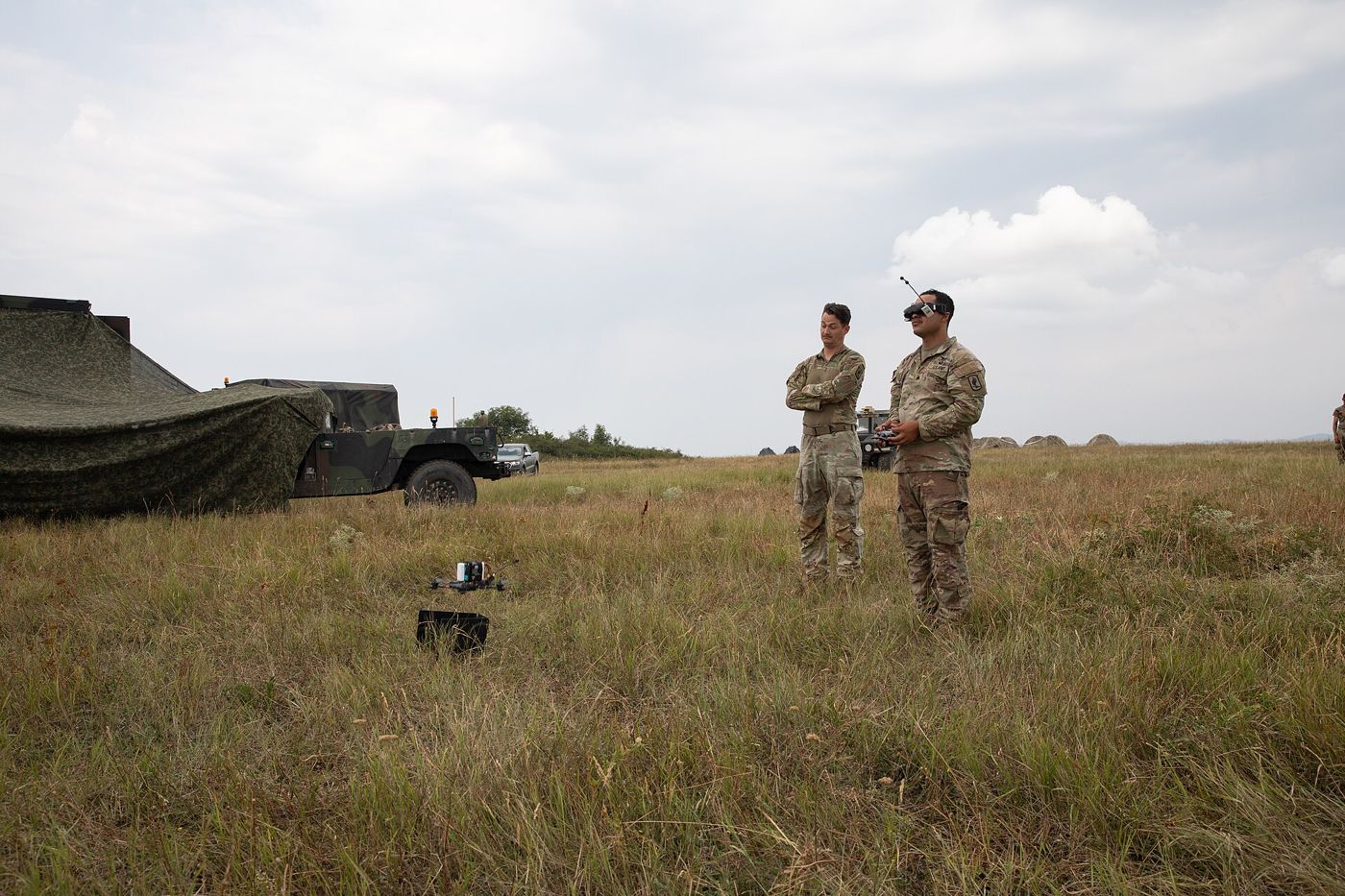
On September 17, about two weeks before the Pentagon’s deadline to put a small attack drone in every Army squad, the colonel who runs the Army’s Drone Dominance effort gave Breaking Defense an unusually plain status report. The service had the airframes. “We do have the volume to do that,” Col. Gregory Merkl said, crediting the Defense Department’s purchasing program. Then he added the part that matters more: “Where we still have some work to do, candidly, is getting everybody trained at the appropriate level.” The capability existed in every platoon, he said, but qualified pilots had not yet reached the squad.
That sentence describes the state of American military autonomy more accurately than any procurement total. Over three years the department has shown that it can announce a quantity, find vendors and take delivery of boxes. Whether those boxes turn into combat power depends on work that no announcement counts: certified operators and the instructors who certify them, bench stock and repair authority, battery and munitions handling, software and spectrum procedures, and a place in the unit’s organization for the people who do all of it. Budgets and press releases tally units bought. They should tally units that are crewed, sustained and used.
Replicator was graded on deliveries and still fell short
The Replicator initiative is the cleanest example of a program built around a number. In August 2023 Defense Department leaders set a goal of fielding autonomous systems “at a scale of multiple thousands” across several domains within 18 to 24 months. When that window closed, DefenseScoop reported on September 3, 2025 that officials would describe only a “successful transition” of proven capabilities to users and declined to give figures. The one public accounting came from T.S. Allen, the former director of Replicator-1 at the Defense Innovation Unit, who said his team had helped supply “hundreds of drones to warfighters,” with “thousands more on contract.”
Even that shortfall was measured in the wrong unit. Hundreds delivered says nothing about how many formations could launch, recover, repair and retask those systems. The department’s response was organizational and financial. Replicator was absorbed in late 2025 by the new Defense Autonomous Warfare Group, and in December Adm. Samuel Paparo of Indo-Pacific Command said the effort was “very much alive.” The fiscal 2027 request then asked for $54.6 billion in research, development, test and evaluation funding for the group, up from $225.9 million a year earlier. That is a request, and by one analyst’s reading only about $1 billion of it sits in the base budget, with the rest in a reconciliation account. It is also an enormous sum attached to an organization whose predecessor could not show that a few hundred systems had been absorbed by the units that received them.
One brigade could fund repairs for half its drones
The small-drone push shows the same pattern at lower echelons. The July 10, 2025 memo “Unleashing U.S. Military Drone Dominance” told the services to account for Group 1 and 2 drones as “consumable commodities, not durable property,” and to equip every Army squad by the end of fiscal 2026. The purchasing followed. The Drone Dominance Program, funded at $1.1 billion, placed its first orders in March 2026 after a vendor competition at Fort Benning. By mid-September units had accepted 12,080 drones of 24,320 on order from 11 companies, and the department expected to order 60,000 more from a second round.
Calling a drone consumable removes the fear of a property-loss investigation. It does not create a supply line. Three soldiers from the multifunctional reconnaissance company of 2nd Brigade Combat Team, 10th Mountain Division, wrote in December 2025 that in the 90 days between collective training and their Joint Readiness Training Center rotation, the company “only managed to acquire funding for services and parts to repair three of its six Vesper UAS systems.” Their proposed fixes were mundane: an authorized bench stock of components at brigade, recurring operations and maintenance money to refill it, and common battery terminals across manufacturers. They also did the arithmetic on people. The company’s three authorized instructor operators, they wrote, lacked the time and resources to train the more than 150 operators the brigade would need to put one in each squad.
Other Army practitioners have described adjacent gaps. A chief warrant officer writing in Army Sustainment in July 2025 observed that munitions maintenance, renovation and modification “have not been done on a large scale by conventional ordnance units” in recent history, which matters once thousands of airframes need warheads attached by someone qualified to do it. In February 2026 the Army’s director of UAS transformation was still asking aloud how many drones, batteries and controllers a squad can physically carry. These are reasonable questions. They were being worked seven months before the fielding deadline, after the purchase quantities had been set.
Operators take months to make, and Ukraine has the data
The Marine Corps offers a useful comparison because it tried to build the training structure alongside the inventory. Col. Scott Cuomo said this spring that the service had gone from zero first-person-view attack drones to more than 3,500. In January it stood up six pilot courses and eight certifications through seven training hubs. The starting base was small. According to The Watch, two 2025 competitions had certified 19 attack drone operators and a deployed expeditionary unit another 14, with hundreds more targeted by May. The Corps deserves credit for publishing a pipeline at all, and the ratio of airframes to certified operators is the figure to watch.
Ukraine’s experience suggests how slowly that ratio moves. An analyst who supports pilot training in the National Guard’s Typhoon unit told Defense News in November 2025 that it takes “at least three months” to bring a pilot from scratch to beginner level. He put the hit rate of new operators at roughly 20 percent and that of the best at 70 to 80 percent, which means crew quality changes the output of a given stockpile several times over. Ukrainian brigades also keep their drones flying through forward workshops of 10 to 12 engineers and technicians inside their drone battalions, who repair airframes, build batteries, adapt ordnance and push software changes. That workshop is force structure, and it is the kind of thing a purchase order does not buy.
None of this is new to the U.S. military. The Government Accountability Office found in 2020 that the Air Force “does not have enough pilots and sensor operators to meet its staffing targets” for remotely piloted aircraft and had been short of instructors at its formal training unit since 2016. In 2022 it reported that the Navy’s estimate of $4.3 billion for 21 uncrewed vessels left out the data repositories and software needed to operate them. The Congressional Research Service, citing a 2025 RAND study, noted in May 2026 that the Army “lacked the means to train sufficient personnel” to operate small drones and had gaps in its doctrine for them.
Report crews and mission-capable rates alongside quantities
The joint force already has a framework for this. DOTMLPF lists doctrine, organization, training, materiel, leadership and education, personnel, and facilities, and materiel is one letter of seven. Uncrewed programs have been run as though it were the only one, with the remaining six left to receiving units to solve out of hide.
Three changes would correct the incentive. Every public and congressional report of uncrewed systems delivered should carry two companion figures: the number of currently certified operators and instructors in the receiving units, and the share of delivered systems that are mission capable. Each purchase should come with operations and maintenance funding for component bench stock and with repair authority at brigade level, so that a consumable drone has consumable parts behind it. And the services should write instructor and maintainer billets into unit authorizations before the airframes arrive, as the 10th Mountain authors asked.
The July 2025 memo did gesture at this. It directed the designation of three national training ranges and the integration of drones into major training events by 2027. Those provisions drew far less attention than the purchase targets, and no leaderboard tracks them. With 60,000 more drones about to be ordered and tens of billions requested for autonomous warfare, the department should publish how many squads can fly and repair what they already hold before it reports how many more have shipped.
This analysis draws on the public sources linked in the text. Send corrections to info@defenseautonomyreview.com.